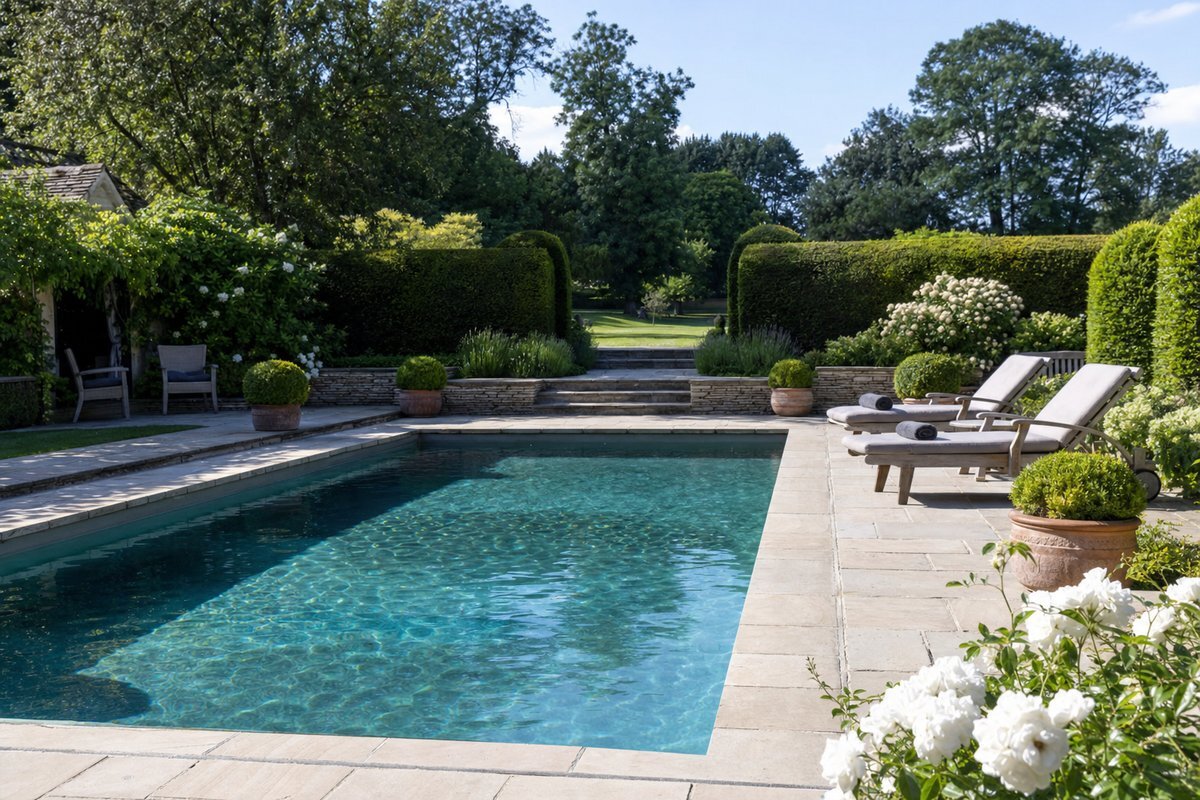



If you have wondered how a pool can stay clear without chlorine, the short answer is biology. Natural pool filtration uses bacteria living on filter media to take phosphate, nitrogen and carbon out of the water, so algae and unwanted bacteria have almost nothing to feed on.
That living layer, called a biofilm, also crowds out bacteria that swimmers bring in. In peer-reviewed lab trials published in npj Clean Water (Nature Portfolio), a biofilter of this kind removed up to 99.9% of test bacteria in 24 hours.
This guide explains how natural filtration works, what that study did and did not show, what we have measured in real pools, and the limits worth knowing before you choose it.
The short version
- Who does the work: bacteria in the filter, not plants.
- What they remove: phosphate, nitrogen and carbon, the nutrients algae and pathogens need.
- The independent evidence: npj Clean Water, 2022. In 24 hours a lab biofilter cut E. coli by 99.4%, E. faecalis by 99.9% and P. aeruginosa by 92%.
- The real-pool record: E. coli not detected in Origin Aqua pools across many years of routine testing.
- What is in the water: no chlorine, no salt, no copper. UV is part of every system.
Natural filtration started in swimming ponds, but the plants were not doing most of the work
A traditional swimming pond has two zones: a deep swimming area and a shallow regeneration zone of gravel and plants. The plants were assumed to clean the water, so the usual answer to cloudy water was more planting.
A plant-only pond typically gives 30 to 50% of its surface to that planted zone. That is a lot of garden to give up, and it is why most people assume a natural pool must look like a pond.
Our PhD microbiologists showed that the bacteria in the gravel, not the plants, were doing most of the work.
Those bacteria removed phosphate, nitrogen and carbon, and starving the water of those nutrients was what made it hard for algae and pathogens to survive.
That changed the design question. If bacteria do the cleaning, they can live in a compact filter in the plant room, and the pool can look like any other pool: no reed beds, indoors or out, heated if you want.
Our guide to natural pools and swimming ponds covers the planted options.
Biological nutrient removal starves algae and bacteria of food
Every pool receives a steady supply of food for microbes: skin cells, sweat, sun cream, pollen, leaves and dust. Chlorine deals with it by oxidising it and killing what grows.
Biological filtration takes a different route. Harmless bacteria eat that food first, and what is left in the water is too lean to support a bloom. This is biological nutrient removal, the same kind of process used to treat wastewater.
Phosphate is the nutrient that limits growth
Algae need phosphate, and in fresh water it is often the nutrient that runs out first. Take it away and algae struggle to bloom, however warm or sunny the week.
The npj Clean Water authors note that in drinking-water systems phosphate is the critical factor that limits or promotes microbial growth. Bacteria in the biofilm take it up as they grow.
mineral+biome® also adds a trace phosphate binder during filtration. It is caught in the filter and removed at backwash, so none stays in the swimming water.
Nitrogen is removed in two steps
Ammonium from sweat and other swimmer inputs is converted by nitrifying bacteria into nitrite, then nitrate. Deeper in the biofilm, where oxygen runs low, other bacteria turn nitrate into nitrogen gas, which simply leaves the water.
In the study's real pond water, ammonium and nitrite fell below the detection limit within 24 hours, and nitrate fell by about 31%.
Swimmers notice nitrogen too. In a chlorinated pool, nitrogen compounds react with chlorine to form chloramines, the cause of the familiar pool smell. Without chlorine, they do not form.
Carbon is food for cloudy-water bacteria
Dissolved organic carbon feeds the general bacteria that turn water cloudy. A mature biofilm consumes it as its own food, which keeps those free-floating populations in check.
In the 24-hour study, general bacterial counts held steady in water passed through the biofilter but rose in water passed through an empty column. Total organic carbon did not change measurably over that short window.
How a biofilter works, step by step
A biofilter is a vessel of filter media with a large surface area. Water flows through it slowly enough for bacteria to settle and build a biofilm: a thin, living layer of many species held together in a sticky matrix they make themselves.
- Bacteria colonise the media. In the lab study the filters were seeded with pond water and given four weeks to mature before any testing.
- The biofilm works like a sponge. Its matrix captures nutrients and fine particles from passing water, even at very low concentrations, and the bacteria use them as food.
- Nutrient levels fall. With phosphate, nitrogen and carbon taken out, the water becomes a poor place for algae and pathogens to grow.
- Newcomers are crowded out. An established biofilm leaves little room or food for incoming bacteria. The researchers call this competitive exclusion: no viable E. coli was recovered from the living media, while sterile media of the same type held around 1,000 per filter.
- UV treats what is left. Every mineral+biome® system includes a UV stage as a second barrier, with the bulb changed yearly.
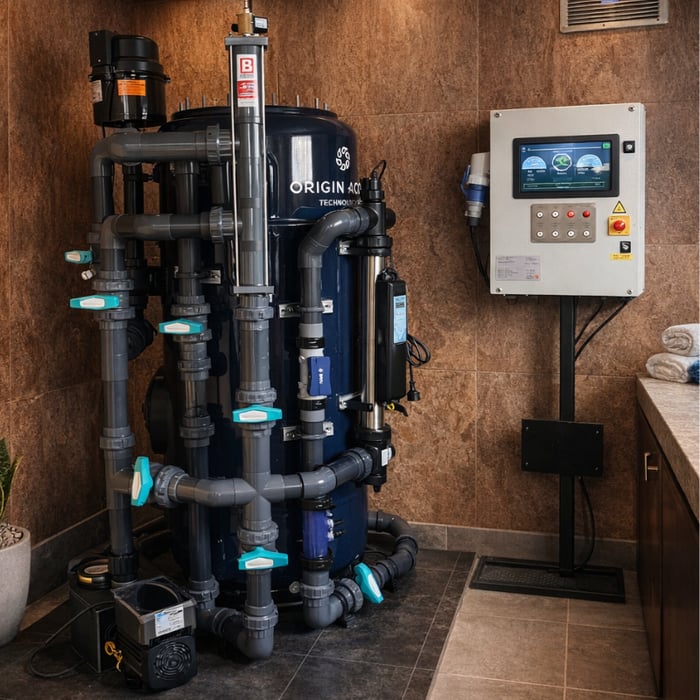
In a mineral+biome® system this sits in a one-piece filter in the plant room, with a mineraliser, a touch-screen controller and an app, so the owner can check the water without opening the plant room. Our technology page shows the full unit.
What the peer-reviewed study actually shows
The research came from a partnership PhD funded by UWE Bristol and Origin Aqua Technologies.
It was published in 2022 in npj Clean Water, a peer-reviewed Nature Portfolio journal, as "The control of waterborne pathogenic bacteria in fresh water using a biologically active filter".
The authors are Steven, Thorn, Robinson, Turner, Lee and Reynolds. Jack Lee of Origin Aqua is a co-author.
The set-up was deliberately simple. Lab-scale columns of ceramic media were matured for four weeks, then water carrying about 1,000 bacteria per 100 mL was recirculated through them for 24 hours.
Two controls ran alongside: the same media sterilised, and an empty column. That isolates the living biofilm from simple straining.
| Test bacterium | Living biofilter, 24 h | Controls, 24 h |
|---|---|---|
| E. coli | 99.4% fewer | Small fall on sterile media; no significant change in the empty column |
| Enterococcus faecalis | 99.9% fewer | Small fall on sterile media; no significant change in the empty column |
| Pseudomonas aeruginosa | 92% fewer | Multiplied in both controls |
The team then ran real surface water from an urban pond through the biofilters. Over 24 hours, E. coli fell by 99.8% and enterococci by 99.4%.
The controls are what make the result useful. Bacteria survived, or grew, in the columns without a biofilm, so the authors concluded the living biofilm was primarily responsible for the reduction.
What we see in real pools
The paper is the independent science. Our own testing is the real-pool record, and the two should not be confused.
Across many years of routine testing, E. coli has not been detected in Origin Aqua pools. UK pool guidance from PWTAG expects E. coli to be absent in a 100 mL sample, so our pools meet the swimming-pool standard for E. coli, without chlorine.
For a wider comparison, the EU Bathing Water Directive rates inland water as "excellent" at up to 500 E. coli per 100 mL. Our results are at least 100 times below that limit.
Wondering whether biological filtration suits your pool?
Tell us the size, whether it is indoors or out, and how it is treated now. We will tell you honestly if it is a fit.
Natural filtration compared with chlorine, salt and planted ponds
The main difference is what keeps the water clear. Chlorine and salt systems rely on a disinfectant in the water; natural filtration relies on removing the food that microbes need.
| System | What keeps it clear | Chlorine in the water | Space needed |
|---|---|---|---|
| Chlorine pool | Dosed chlorine | Yes | Plant room |
| Salt water pool | Chlorine made from salt in an electrolytic cell | Yes | Plant room |
| Plant-only swimming pond | Plants and gravel bacteria | No | Planted zone of 30 to 50% of the surface |
| mineral+biome® | Biofilter nutrient removal plus UV | No chlorine, salt or copper | Plant room |
Salt is the comparison most people get wrong: a salt water pool still produces chlorine, it simply makes it on site. Our article on whether salt water pools are chlorine free explains why.
Running costs differ too. By our own figures, mineral+biome® uses 50 to 70% less energy and 50 to 70% less water than chlorine or salt.
Frequently asked questions about natural pool filtration
What is natural water filtration?
Natural water filtration cleans water through physical and biological processes rather than an added disinfectant.
It is the principle behind the slow sand filters used in water treatment. In a pool, it means bacteria on filter media remove nutrients and crowd out unwanted bacteria.
How does a natural pool stay clean without chlorine?
The biofilter removes the phosphate, nitrogen and carbon that algae and bacteria need, and the established biofilm crowds out newcomers. A UV stage treats the water as a second barrier, and the filter is backwashed to remove trapped debris.
Is natural pool filtration safe to swim in?
Across many years of routine testing, E. coli has not been detected in Origin Aqua pools, which meets the UK swimming-pool standard for E. coli without chlorine. Independently, the npj Clean Water study found up to 99.9% of test bacteria removed in 24 hours in lab trials.
Can natural filtration work in a heated or indoor pool?
Yes. mineral+biome® works indoors and outdoors with water up to 30 °C. Indoor pools gain the most, because without chlorine there is no chloramine vapour in the air.
How long does a biofilter take to establish?
You can swim the same day the system is installed. The biology takes 6 to 8 weeks to reach full balance, which is why the system includes UV from day one.
Can I convert my existing pool to natural filtration?
Yes. mineral+biome® retrofits to existing pools in 1 to 2 days with no changes to the pool's plumbing. Our guide to retrofitting a pool covers what is involved; payback is typically 3 to 7 years, depending on pool type and size.
Does a natural pool need plants?
No. The 2013 research showed bacteria in the gravel do most of the nutrient removal, so the filter can sit in the plant room. In a new-build natural pond designed around mineral+biome®, the planted zone can typically shrink to about 20% of the surface.
Water that looks after itself
Nature has always cleaned water without chlorine. Our work since 2010, across more than 200 UK pools, has been to put that process in a filter that fits a normal plant room and keep it measurable.
If you are planning a pool or thinking about changing the one you have, the first conversation is simple: tell us about the pool and we will tell you whether natural filtration is a fit, with a written price before anyone visits.
Interested in mineral+biome® for your pool?
Tell us about your pool, new build or existing, and we'll tell you whether it's a fit.
A note on terminology: By chemical-free we mean no disinfection chemicals (no chlorine, bromine, salt chlorination or copper) and no chemical residuals in the swimming water. Trace phosphate management agents are used automatically during filtration: these bind to phosphates and are removed entirely during backwash, leaving no residual in the water. Mineral supplements are used in trace amounts in a food-grade carrier. Read our full definition.
Talk to us about your pool
A written price before anyone visits · No obligation, no sales pitch · Talk to an Origin Aqua pool owner

Kate Winslet Chooses a Mineral Water Pool
Chemical-Free Pools: The Opportunity for Pool Builders