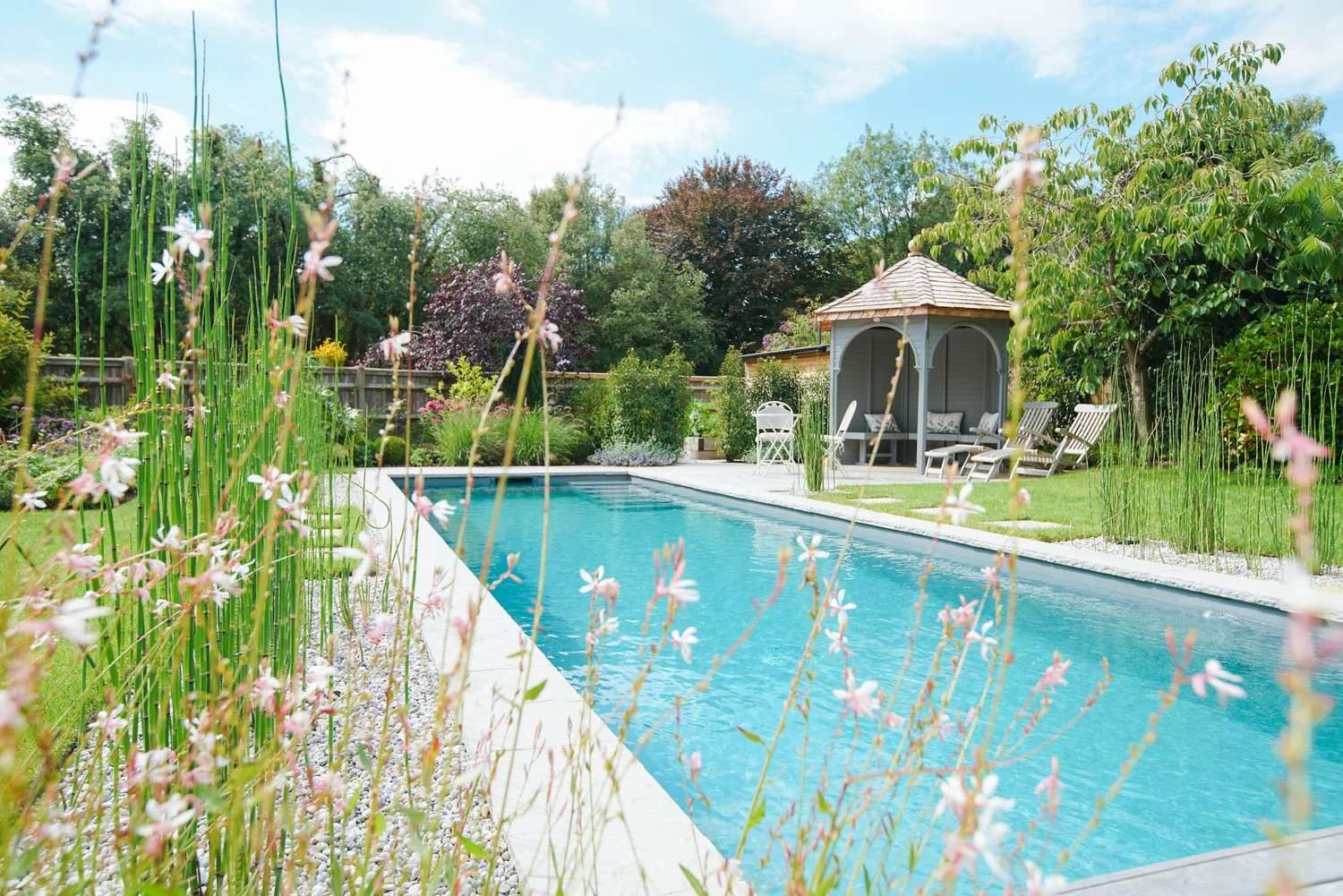

An infinity pool is a swimming pool with one or more edges built slightly below the water line, so the water spills over and seems to run into the view beyond. It is also called a negative-edge, vanishing-edge or zero-edge pool.
The effect looks simple. Underneath sits a second hidden tank, an extra pump and a level of build accuracy no other pool shape needs. This guide covers how an infinity pool works, what it adds to a UK budget, the design choices, and the honest downsides.
Origin Aqua has been treating pool water without chlorine since 2010, in 200+ UK pools. We don't build pools, so this advice isn't selling you a shape. Ask us about your project →
How an Infinity Pool Works: Weir, Catch Trough and Balance Tank
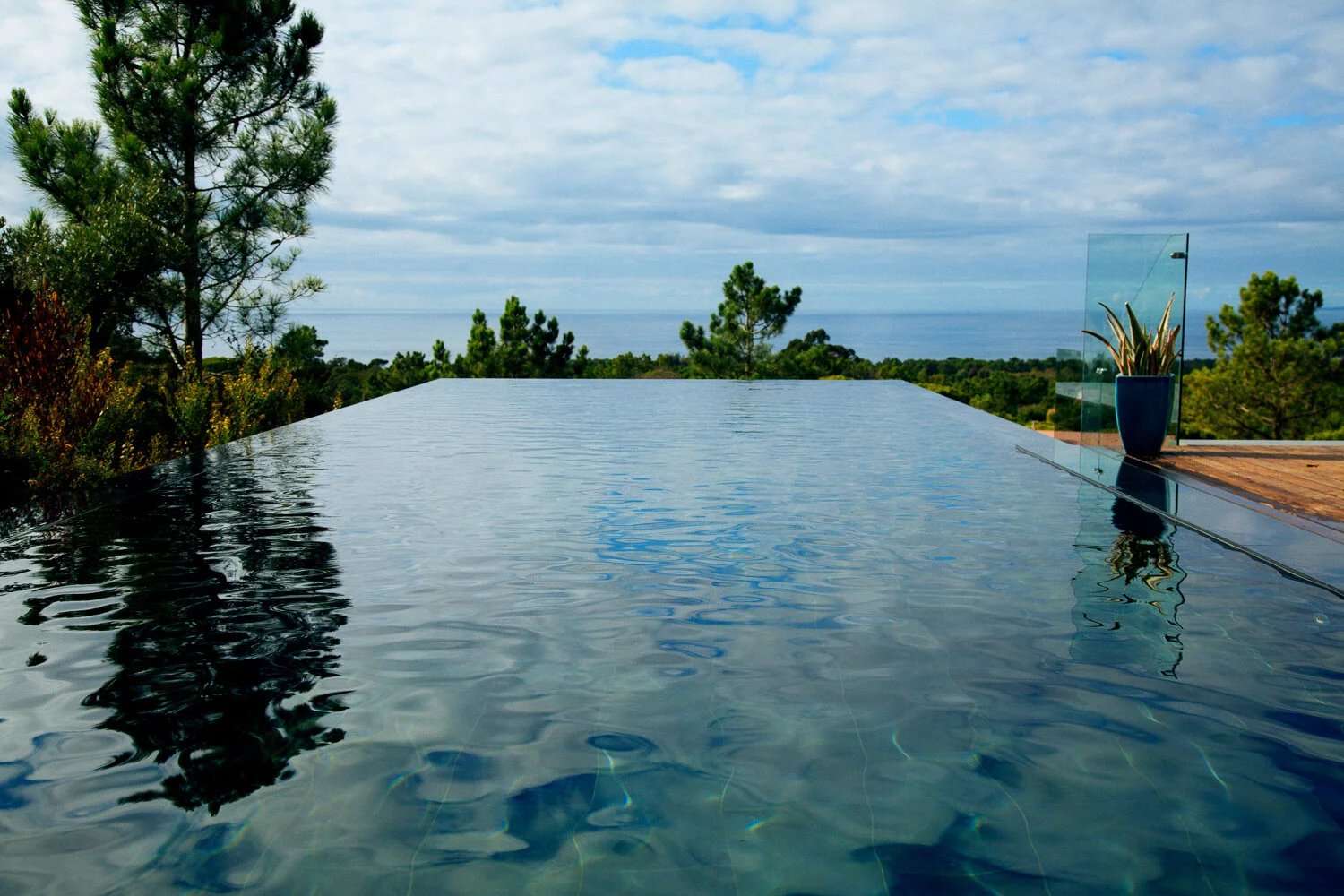
The vanishing side of the pool ends in a weir: a wall whose top sits just under the normal water level. UK builder Blue Pools puts it at about 15 mm below the median water line (Blue Pools).
Water flows over the weir as a thin sheet and falls into a catch trough that runs the full length of the edge. From there it drains to a balance tank, usually buried out of sight, and a pump sends it back into the pool.
The balance tank is not optional. It has to absorb the water that swimmers push over the edge, plus wind, waves and rain, without overflowing or running dry. An automatic top-up keeps the level right.
So every infinity pool is really two connected vessels: the pool you swim in, and a tank you never see.
Infinity Pool vs a Regular Pool: What Is Different
A regular pool holds its water several centimetres below the coping and skims it through wall skimmers. An infinity pool adds four things:
- A weir edge built level to within millimetres along its whole length
- A catch trough under that edge, which collects leaves and grit as well as water
- A balance tank with its own excavation, waterproofing and pipework
- A second pump and controls to run the overflow, ideally variable speed so the flow can be turned down
Everything else, from the shell to the heating, is the same decision you would make for any pool.
How Much Does an Infinity Pool Cost in the UK?
Start with the cost of a standard pool of the same size, then add the edge. Blue Pools estimates the extra for one infinity edge on a 12 x 6 m pool at around £8,000 to £10,000 excluding VAT (Blue Pools). That is one builder's figure, so ask every quote to price the edge as a separate line.
The base pool is the larger number. Our UK swimming pool cost guide breaks down where that money goes. Three things push the infinity premium up:
- More than one vanishing edge: a longer weir, a longer trough and more water in motion
- A sloping site: the trough wall and balance tank often need retaining structures
- Finishes on the outer face: the wall below the weir is on show, so it gets tiled or clad
Then there are running costs a standard pool doesn't have: the overflow pump, the water lost to evaporation from the moving sheet, and the heat that goes with it. Those depend on how many hours a day the edge runs.
Infinity Pool Design: The Choices That Matter
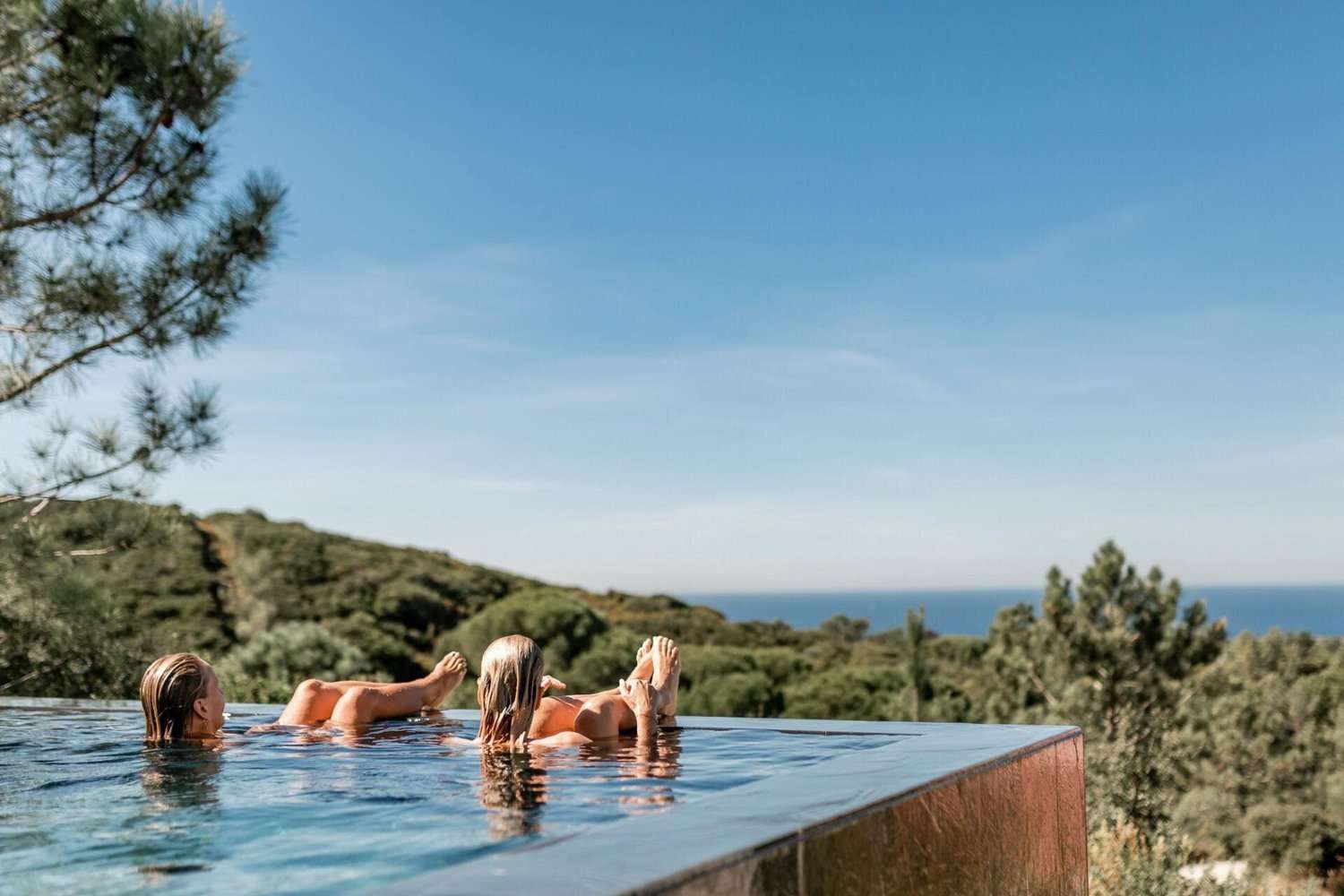
Point the edge at the view. The effect only works when the eye travels over the edge to something: a valley, open fields, the sea. With nothing to frame, a vanishing edge looks like a wall with water on it.
Work out where you will stand. The illusion is seen from one side of the pool, usually the house or the terrace. Design the edge for that sightline, not for the drawing.
One edge or several. A single vanishing edge gives most of the effect. Each extra edge adds trough length, water in motion and cost.
The slope does half the work. On a falling site the trough sits below the weir, out of sight. On a flat garden it has to be hidden by planting or a lower terrace, or it shows.
Choose the outer face with care. Water runs over it every time the edge is on, so its finish is on show for the life of the pool. Agree the material and the maintenance with your builder at design stage.
Why Infinity Pools Need Very Accurate Construction
On a conventional pool, a coping edge a few millimetres out of level is invisible. On an infinity pool, it is the whole problem.
Water only spills evenly if the weir is level along its full length. A small error and the water runs thick at one end and barely trickles at the other, which breaks the sheet that makes the edge disappear.
There is no adjustment that fixes a badly built weir afterwards. It has to be rebuilt. That is also why an infinity edge is rarely added to an existing pool: it means cutting out and rebuilding a wall, plus a new trough and tank.
Infinity Pools in the UK Climate: Heat, Water and Leaves
Moving water loses heat and water faster than still water. An infinity edge keeps a thin sheet of water moving and exposed to the air across its whole width, so evaporation is higher than on a standard pool of the same area.
In the UK that matters more than in a hot climate. Evenings are cooler, wind is common, and a heated pool loses the most where the water is most exposed. Leaves and rain also end up in the trough and the balance tank, so the top-up and the debris both need watching.
Two things keep it under control:
- A cover. A slatted floating cover suits an overflow edge better than a loose solar cover.
- Controls that switch the edge off. Running the overflow day and night, whether anyone is swimming or not, is the easiest way to turn its running costs into a problem.
If you plan to heat the pool, size the heating with the edge in mind. Our guide to heating a swimming pool compares the options.
Infinity Pool Water: Treatment and Balance
The water you treat is the pool plus the trough plus the balance tank. Whatever system you choose has to be sized for the whole volume, not just the part you swim in.
In a chlorinated pool, the edge also changes the water chemistry. Tumbling water loses carbon dioxide much faster than still water, which pushes the pH up, so infinity edges and waterfalls typically need more pH correction (WaterShapes).
The trough is the other weak point. Leaves and grit collect there and rot, feeding algae with the nutrients it needs. Clearing it often matters on every vanishing edge.
Origin Aqua's Mineral+Biome® system works on that nutrient side. Living microbial filtration removes the phosphate, nitrogen and carbon that algae and bacteria need, with no chlorine, salt or copper in the water (what we mean by chemical-free). UV is part of every system.
Lab trials published in npj Clean Water (Nature Portfolio) showed up to 99.9% of test bacteria removed in 24 hours. The system treats an infinity edge the same way as any other pool shape. See how the technology works.
Planning an infinity pool?
Infinity edges lose more water and heat, so your treatment and heating choices matter more. We can specify both from the start.
Maintaining an Infinity Pool
Every leaf that lands near the weir washes over and settles in the catch trough. Check and clear it regularly through the whole season, not just at opening.
The overflow pump runs whenever the edge is on, so it works harder than a standard filter pump and needs servicing more often. Watch the balance tank level too: too low and the pump can run dry, too high and the tank overflows.
Most new owners underestimate this in the first year. Build it into the service plan from day one.
The Deck-Level Alternative: A Similar Look, Different Trade-Offs
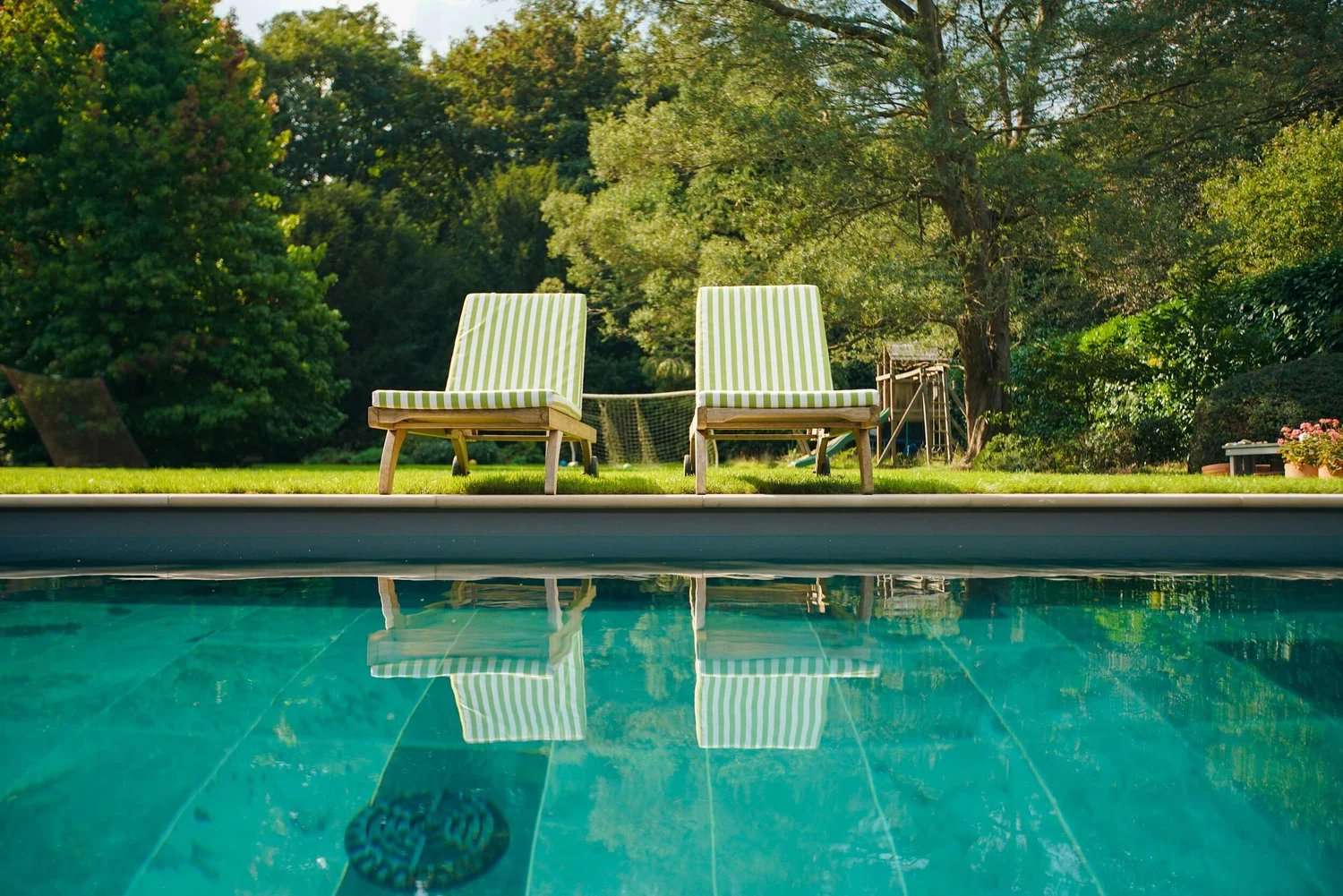
A deck-level pool holds the water almost level with the coping instead of several centimetres below it. The water reads as flush with the terrace, on every side, without needing a view.
There are two ways to build one. A skimmer deck-level pool uses specialist skimmers that work at the higher water line, with no balance tank. A full overflow deck-level pool spills water into a channel around the whole perimeter and does need a tank.
Don't assume deck level is the cheaper route. Blue Pools says a deck-level pool costs more than an infinity pool of the same size with one vanishing edge (Blue Pools). Ask for both to be priced if you are torn.
Is an Infinity Pool Worth It? The Disadvantages to Weigh
If the site has a view worth framing and the look matters to you, a vanishing edge gives you something no other shape can. Without a view, most of the reason for it disappears.
The disadvantages are all about the overflow system:
- A higher build cost than a standard pool of the same size
- Extra running costs: the overflow pump, evaporation and heat loss
- More maintenance: the trough, the balance tank level, more pH correction in a chlorinated pool
- No room for error in construction, and hard to add later
If low running costs and simplicity matter most, compare a deck-level or a standard pool before you commit.
Talk to us before the design is fixed
Independent advice on water treatment and heating for infinity and deck-level pools.
Infinity Pool FAQs
What is an infinity pool also called?
Negative-edge, vanishing-edge, zero-edge or infinity-edge pool. Some builders also say overflow or spillover pool. They all describe the same idea: water spilling over an edge into a hidden trough.
Where did infinity pools come from?
Architect John Lautner is credited as one of the first to design them in the US, in the early 1960s. He also created the vanishing-edge pool in the 1971 Bond film Diamonds Are Forever (Wikipedia).
Can you swim in an infinity pool?
Yes. It swims like any other pool. The vanishing edge is a solid wall you can rest your arms on, with only a thin film of water running over it.
What happens if you fall off the edge of an infinity pool?
On the outside of the edge is the catch trough, not open air. How far below the edge it sits depends on the site, so on a steep slope ask your designer how the outer side is made safe. Standard pool safety, from fencing to supervision, applies as with any pool.
What is the average cost of an infinity pool?
The cost of a standard pool of the same size plus the edge. One UK builder puts a single infinity edge on a 12 x 6 m pool at around £8,000 to £10,000 excluding VAT. See our UK swimming pool cost guide for the base figures.
Do I need planning permission for an infinity pool in the UK?
The same rules apply as for any garden pool, and many fall under permitted development. The balance tank and any retaining walls on a sloping site can raise extra questions. Read our planning permission guide before the design is fixed.
Can you add an infinity edge to an existing pool?
Rarely without major work. It means cutting down and rebuilding one wall as a weir, then adding a trough, a balance tank and a pump. Treat it as a rebuild of that side of the pool.
Considering an infinity pool, a deck-level pool, or unsure which suits your site? Get a free specification →
Talk to us about your pool
A written price before anyone visits · No obligation, no sales pitch · Talk to an Origin Aqua pool owner

What Is a Natural Swimming Pool? Types, UK Cost and Swimming Ponds Compared

How to Heat a Swimming Pool: Every Method Compared